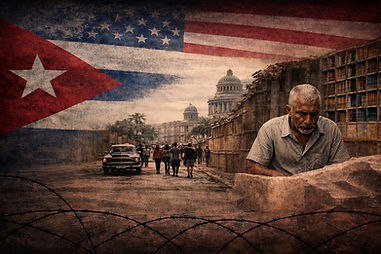

CUBA and the blockade
The extraordinary story of how a Caribbean island has survived 60 years of blockade and remains standing.
Independent project in development · Voluntary support · Non-partisan

THE BLOCKADE
The economic, commercial, and financial blockade—also known as the U.S. embargo—has been imposed on Cuba since the early 1960s.
Over the decades, it has become a complex web of laws and regulations. Through strict sanctions, it restricts economic activity not only between Cuba and the United States, but also with other countries and entities. Its reach extends beyond U.S. borders, affecting companies and governments that trade with Cuba.
Because of its extraterritorial impact, many governments and international organizations have considered it illegitimate and unlawful.
Nowhere else in the world is there a country at peace where such severe shortages of basic necessities are so visible. Nor is there another nation subjected to a unilateral embargo of this scale for so long.
Its objective is clear: to weaken the economy to the point of destabilization, ultimately forcing regime change.
More than six decades later, it remains a U.S. foreign-policy failure—sustained largely by domestic political interests.
Blockade or Embargo?
The purpose of this documentary is not to construct a unilateral narrative, but to explore how this policy — referred to as a “blockade” in Cuban discourse due to its practical effects, and as an “embargo” within the U.S. legal framework — has become a central factor in the island’s economic and social life.
After more than six decades of restrictions, a complex scenario has taken shape, requiring a clear distinction between its legal dimensions, its operational impacts, and the political interpretations associated with each term. Understanding these differences will be essential to the development of the documentary.


THE WORLD
A vote that repeats… and changes nothing
Every October, for the 33rd consecutive year, the UN General Assembly votes on a resolution (No. 79/7) calling for an end to the embargo against Cuba.
Overwhelming support
On average, more than 180 countries vote each year in favor of ending the embargo.
But nothing changes
Despite this broad international support, U.S. policy remains unchanged. Year after year, the power of the United States—and occasional allies—prevents that global consensus from translating into real action
The unavoidable question
So what are the United Nations for, if this repeated vote cannot lead to change?

Overwhelming support
On average, more than 180 countries vote each year in favor of ending the embargo.
But nothing changes
Despite this broad international support, U.S. policy remains unchanged. Year after year, the power of the United States—and occasional allies—prevents that global consensus from translating into real action
The unavoidable question
So what are the United Nations for, if this repeated vote cannot lead to change?


The documentary project: BLOCKEADE LIFE
Living the blockade is an independent documentary that portrays the historical context of the U.S. embargo on Cuba and analyzes its economic and social effects on everyday life.
The documentary combines documentary research, source review, archival material, and firsthand testimonies to offer a contextualized and accessible understanding of a complex and long-standing process.
Its objective is to produce an informative, accessible, and evidence-based audiovisual piece aimed at audiences interested in history, society, and international relations.
For more than six decades, Cuba has lived under a policy that often appears in headlines, speeches and debates, but is rarely explained in depth: the embargo —or blockade— imposed by the United States.
For many people, the topic seems distant. Diplomatic. Repetitive.
But its consequences are not abstract. They are experienced every day.
This work led to the production of the documentary: LIVING THE BLOCKADE , directed by Eduardo Flores , currently in the development stage.
This documentary not only seeks to describe the material impact of restrictions imposed for decades—which have limited or eliminated access to essential inputs such as medicines, hydrocarbons, technologies, and financial services—but also to understand their historical, political, and human dimension.
Because behind every resolution, every sanction, and every figure, there is a daily life marked by limits that are not always seen... but that are felt.
We will address the topic from a broad perspective: its origin, the moments of greatest tension, the attempts at rapprochement—such as the normalization process between the governments of Barack Obama and Raúl Castro in 2014–2016—, the subsequent setbacks and, above all, the impact of the blockade on the lives of those who live on the island.
Its effects are evident and deeply painful.

Nuances. Not slogans.
The purpose is not to construct a one-sided discourse.
Our goal is to show how this policy—called “blockade” in Cuban discourse because of its practical scope and “embargo” in US legal language—has become a central factor in Cuba’s economic and social life.
Six decades of restrictions have created a complex scenario. Therefore, any serious analysis requires distinguishing between the legal dimension (embargo), the operational dimension (blockade), and the political interpretations that accompany each term. This distinction will be a fundamental part of the documentary.
Revolution and hope
It will also be the story of a revolution, a dissent, a political struggle for a peaceful solution, and a hope that seems to be dying out, but does not disappear completely.
What does this project aim to contribute?
We will produce a documentary that provides clarity, historical context, and rigorous analysis. A project that offers context, reveals nuances, and contributes to a more informed public conversation.
It is a work designed for those seeking to understand in depth a phenomenon that has marked generations.

Why does it matter?
Although few issues in contemporary geopolitics have been debated as much as the U.S. economic and commercial embargo on Cuba, over time it has become part of everyday language. It no longer surprises anyone—it is treated as a given, absorbed into the status quo.
It has become part of the political and media landscape across the continent: it is frequently mentioned, but rarely examined in depth. And when it is discussed, public debate often relies on repeated narratives, manipulated figures, or partial interpretations that fail to capture its complexity or its real consequences.
For decades, a simplified idea has been repeated: “Cuba deserves it.”
That phrase, rather than explaining, shuts down the conversation.
Our goal: to break that inertia
We want to offer a clear, accessible, and well-grounded analysis. We believe this situation carries an ethical responsibility: to document the real human impact of these policies and to open space for informed debate—especially for the new generations who will inherit this discussion.
In this work, we will bring together the history and effects of the embargo. We will explore its origins, as well as the daily life of Cubans who were born and have learned to live under these restrictions.
We will hear—from diplomats, academics, and social advocates across the political spectrum—the reasons and arguments that sustain this conflict, which far from being resolved, seems increasingly difficult to move toward a fair and equitable outcome.
The documentary’s goal is to build a comprehensive narrative, with diverse voices, in order to understand different angles and perspectives. Because only by understanding it clearly can we move the conversation forward.
What will this documentary be used for?
It will be a tool to raise awareness and share rigorous information, in a context where discussion of the topic often circulates in partial or distorted ways.
It will serve as a resource for understanding and public discussion in educational spaces, civil society organizations, and international forums—an effort to encourage serious, well-documented reflection.
Present and future generations will find in this work a guide to understanding a prolonged conflict, its real consequences, and the ethical questions that remain open.


Why is it important to support this project?
The United States' economic and commercial blockade of Cuba, has become part of the common language; it no longer surprises anyone, it is taken for granted, it is part of the status quo, having been integrated into the political and media landscape of the continent: it is frequently mentioned, but little studied.
Most public discussions rely on repeated narratives, manipulated figures, or partial interpretations that prevent an understanding of its complexity or its real consequences.
Your donation makes this documentary possible and helps us produce it independently.

Every contribution helps advance knowledge, preserve memory, and inspire dialogue.

Challenging the embargo, one donation at a time
Why crowdfunding?
Given the political and legal nature of the topic, we chose crowdfunding as our approach: bringing together many small contributions from people who connect with the purpose of this documentary.
Why not use platforms like GoFundMe?
We decided not to use platforms such as Kickstarter, Indiegogo, or GoFundMe because they operate under U.S. jurisdiction. As a result, funds raised through those services may be subject to restrictions, limitations, or review processes related to U.S. embargo regulations.
How will this work?
Our strategy prioritizes:
-
Direct contributions
-
Transparency in how resources are used
-
Recognition in the documentary’s final credits
This model is not only a practical decision—it is also a coherent way to build the project collectively.

Your support makes this documentary possible.
An independent research project
Each contribution drives the research, production, and dissemination of the project.
Select a support level to learn about the benefits and make your donation.
SUPPORT I
It promotes research and gives space to voices that are rarely heard.
$29 USD
SUPPORT II
Actively supports the making of the documentary.
$118 USD
SUPPORT III
Strengthens the project’s editorial, political, and ethical independence.
$294 USD